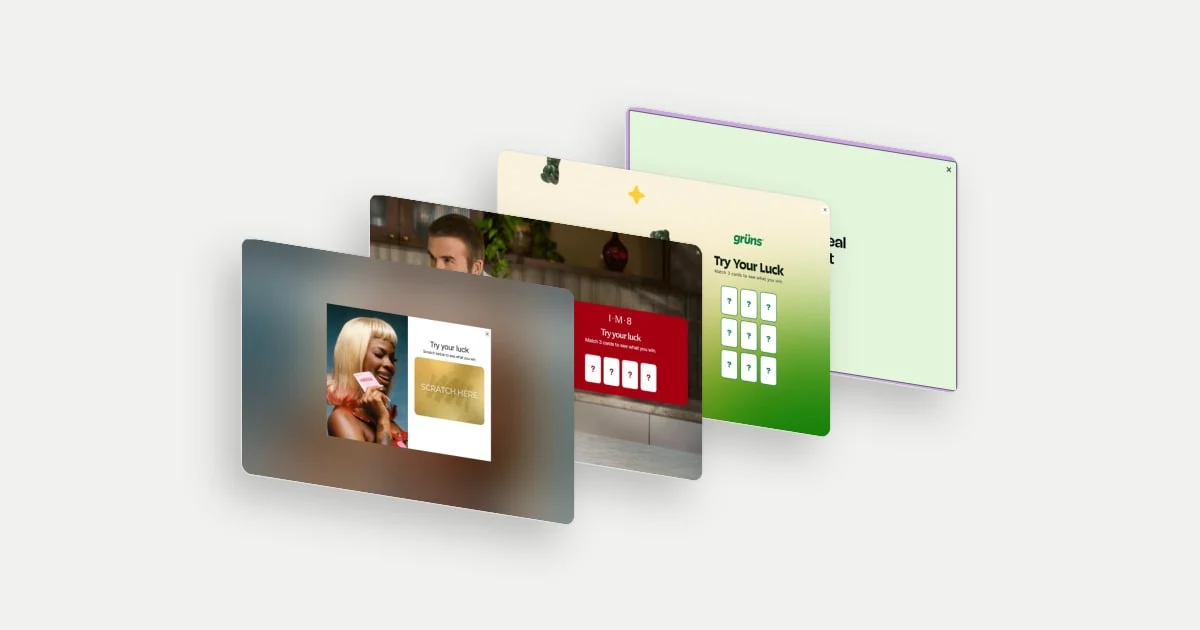
A gamified signup popup swaps the usual "enter your email for 10% off" for a small task: scratch a card, match three, pick a tile. The shopper's question is the same as ever, what will I get, and what do you want from me?, but it arrives with a moment of play.
These five examples come from stores in the library: two scratch cards, two card-matching games and one pick-a-tile screen. Four are desktop states; Smooche was captured on a phone only. Each capture shows the popup's opening state. We did not play the games, enter an email address or see a prize, so this article describes the invitation, not the outcome.
Why stores use a game instead of a form
The offer can be identical either way. What changes is how the discount is revealed. Alia, the popup app behind all five examples, describes its scratch-off as a step that covers a reward so visitors scratch it away with a mouse or finger, turning the opt-in into a quick, hands-on game.
Popup vendors report that this pays off. Claspo's benchmark of popups published by its own users (3 years, 779 million impressions, October 2025) puts gamified signup forms at 9.18% against 3.53% for all signup forms. By mechanic it reports scratch cards at 11.29%, spin to win at 9.25% and gift boxes at 7.26%.
Read those numbers with care. They come from one vendor's customers, not from independent testing, and they say nothing about the five stores below. A higher signup rate is also not a higher sales rate: someone who joins for a prize may never buy at full price.
| Mechanic | What the visitor does | Seen here |
|---|---|---|
| Scratch card | Rubs away a covered panel | Topicals, Smooche |
| Card matching | Reveals cards until three match | IM8, Grüns |
| Pick a tile | Chooses one of a few hidden tiles | Hey Bud |
Five gamified popup examples
1. Topicals: make the card look scratchable
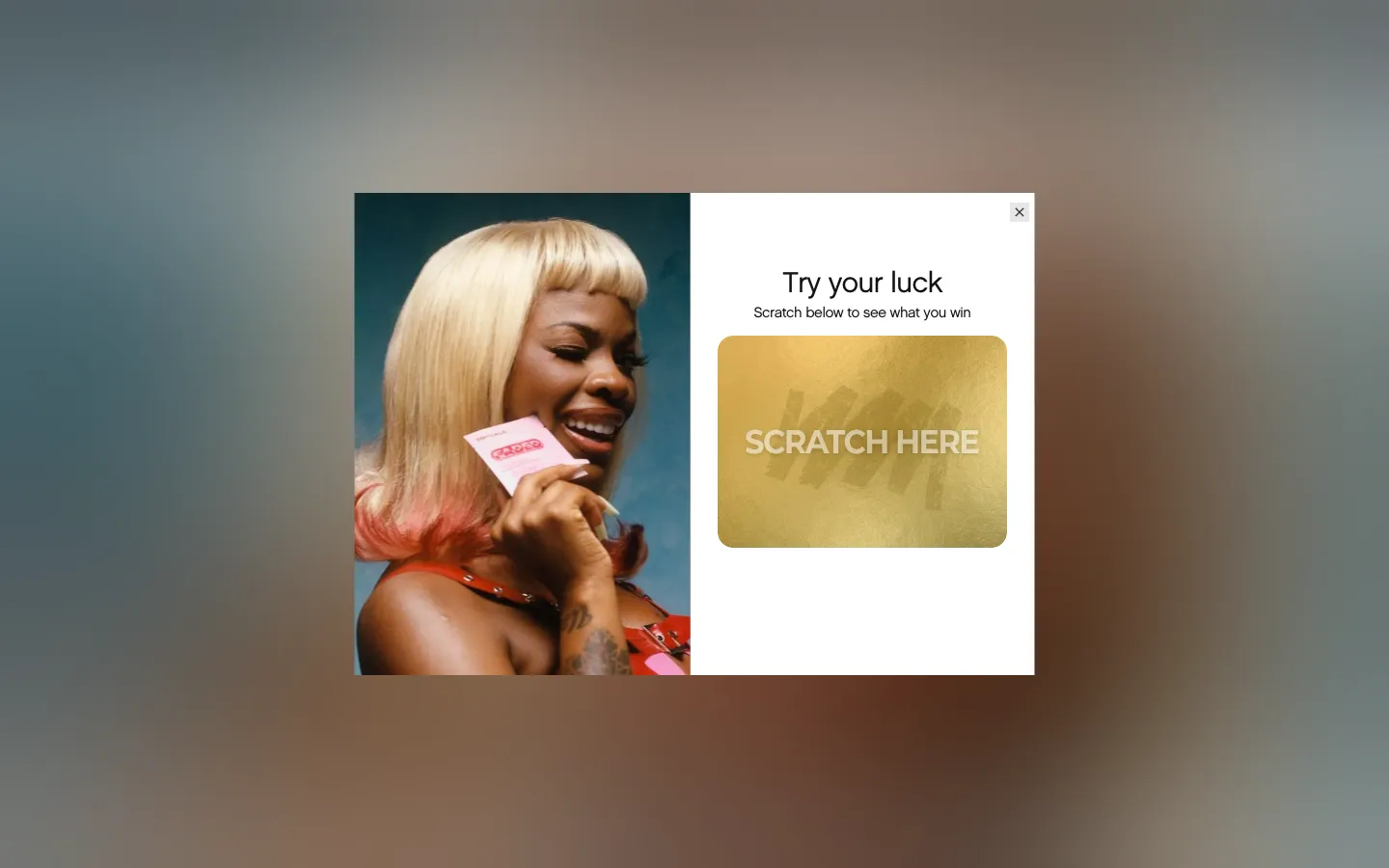
Topicals places a portrait of a person holding a product pack beside a compact card. The headline is two words, "Try your luck", followed by one instruction: "Scratch below to see what you win". The play surface is a gold, foil-textured panel with the words SCRATCH HERE across it. It looks like a real scratch card, so the shopper does not need a tutorial to know what to do.
2. Smooche: the same game on a phone
Smooche's capture is a phone screen, and the game takes most of the width: the same two-line invitation, then a large gold panel to scratch. On a phone the visitor uses a finger, and Alia says the scratch step works with a mouse or finger. A large target suits that.
The words match Topicals exactly: "Try your luck" and "Scratch below to see what you win". That suggests both start from the app's template, though we have not confirmed it.
3. IM8: keep the brand image and add a compact game card
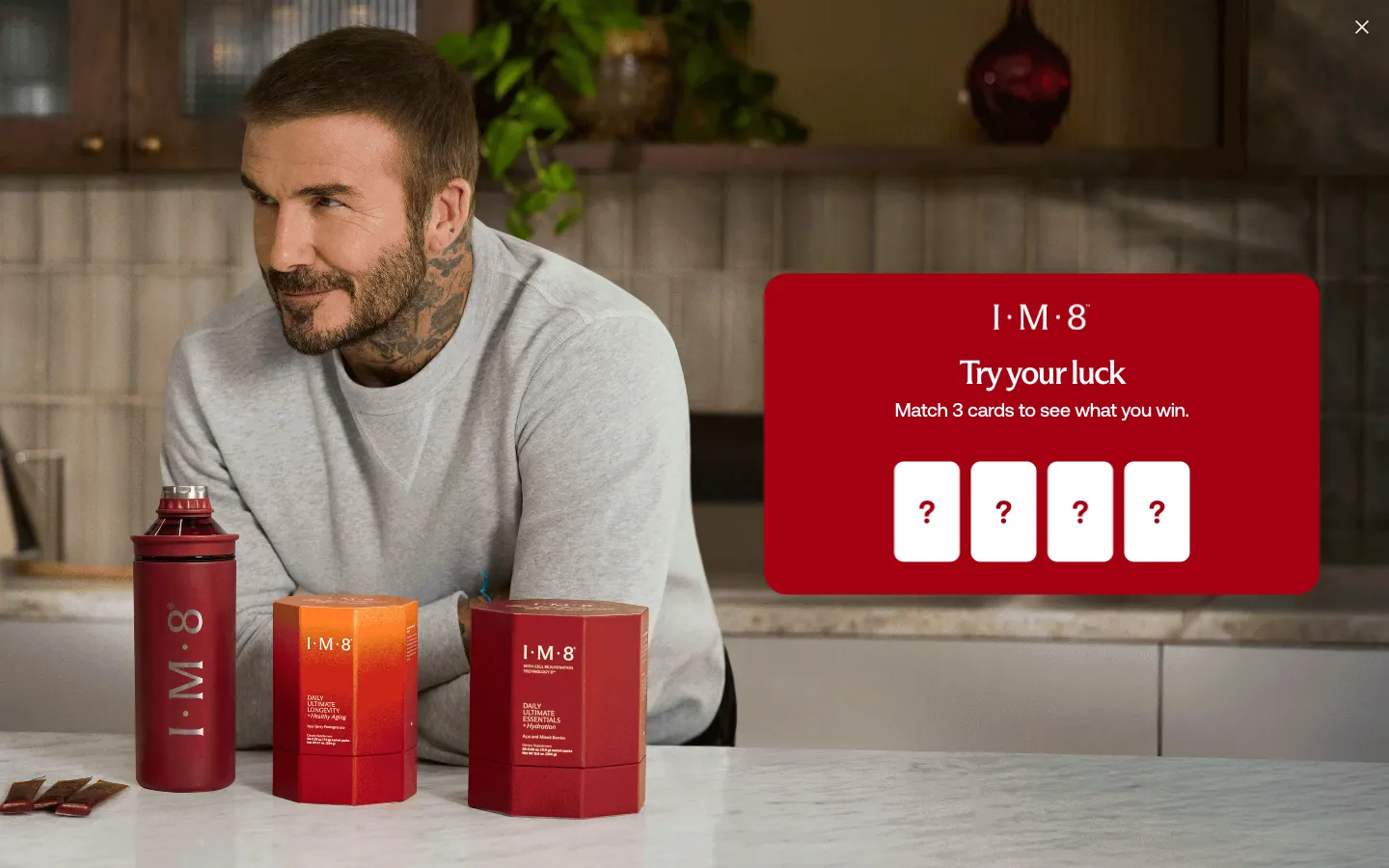
IM8 leaves its photograph almost untouched. David Beckham and three pieces of red IM8 packaging fill the screen, and a compact red card in the upper right carries the game: "Try your luck", then "Match 3 cards to see what you win", then four face-down cards. The red of the card echoes the packaging, so the popup looks like part of the picture rather than a layer on top of it.
The rule of the game sits in one sentence under the headline.
4. Grüns: let the brand's world carry the game
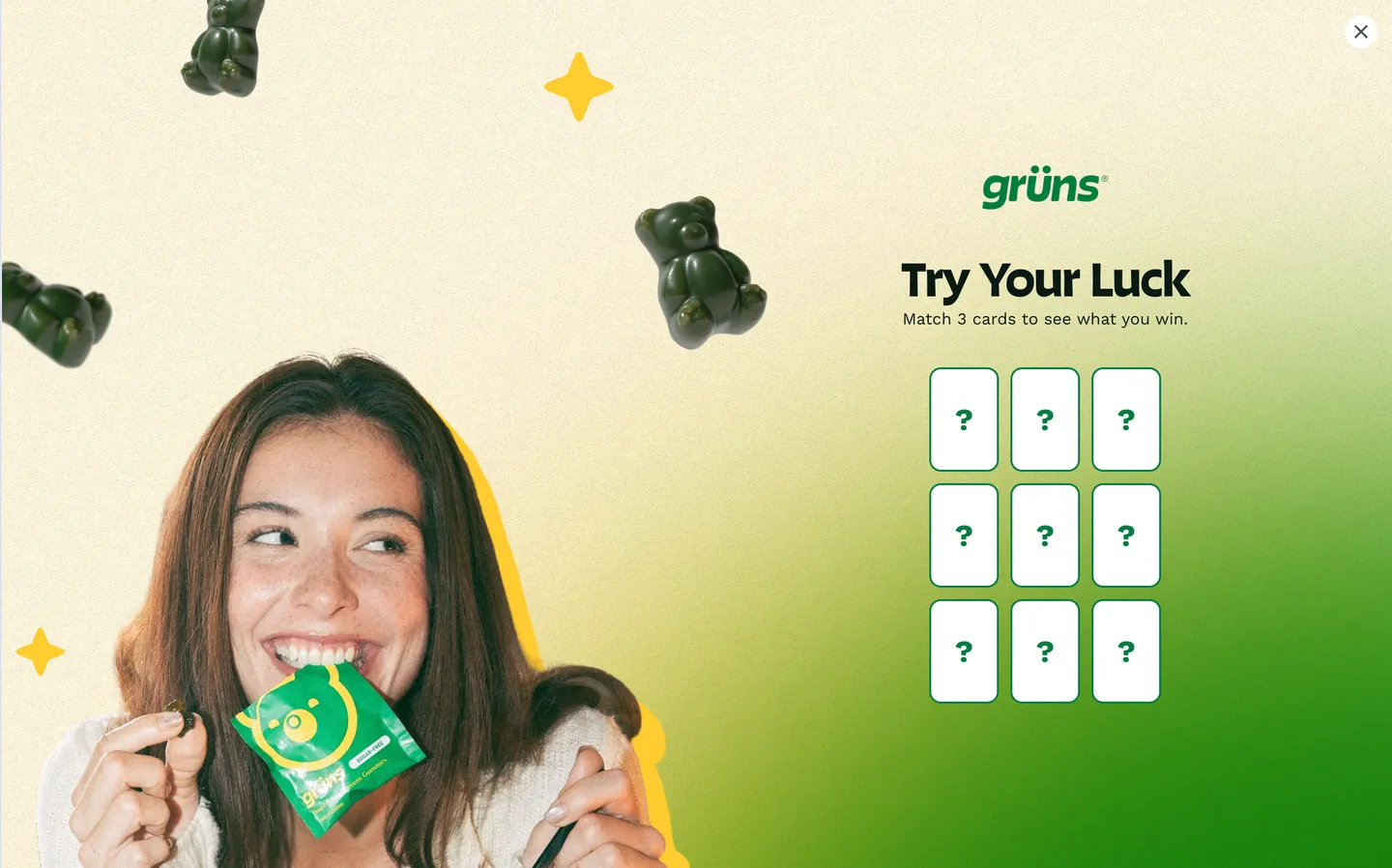
Grüns uses the whole screen. On the left, a smiling person eats from a pack of gummies; scattered green gummy bears and stars run through a green-to-cream gradient. On the right sit the Grüns logo, "Try Your Luck", the same matching rule as IM8, and a three-by-three grid of face-down cards. The game uses the brand's own characters and colours, so it reads as a brand moment rather than a generic discount window.
5. Hey Bud Skincare: one choice, nothing else
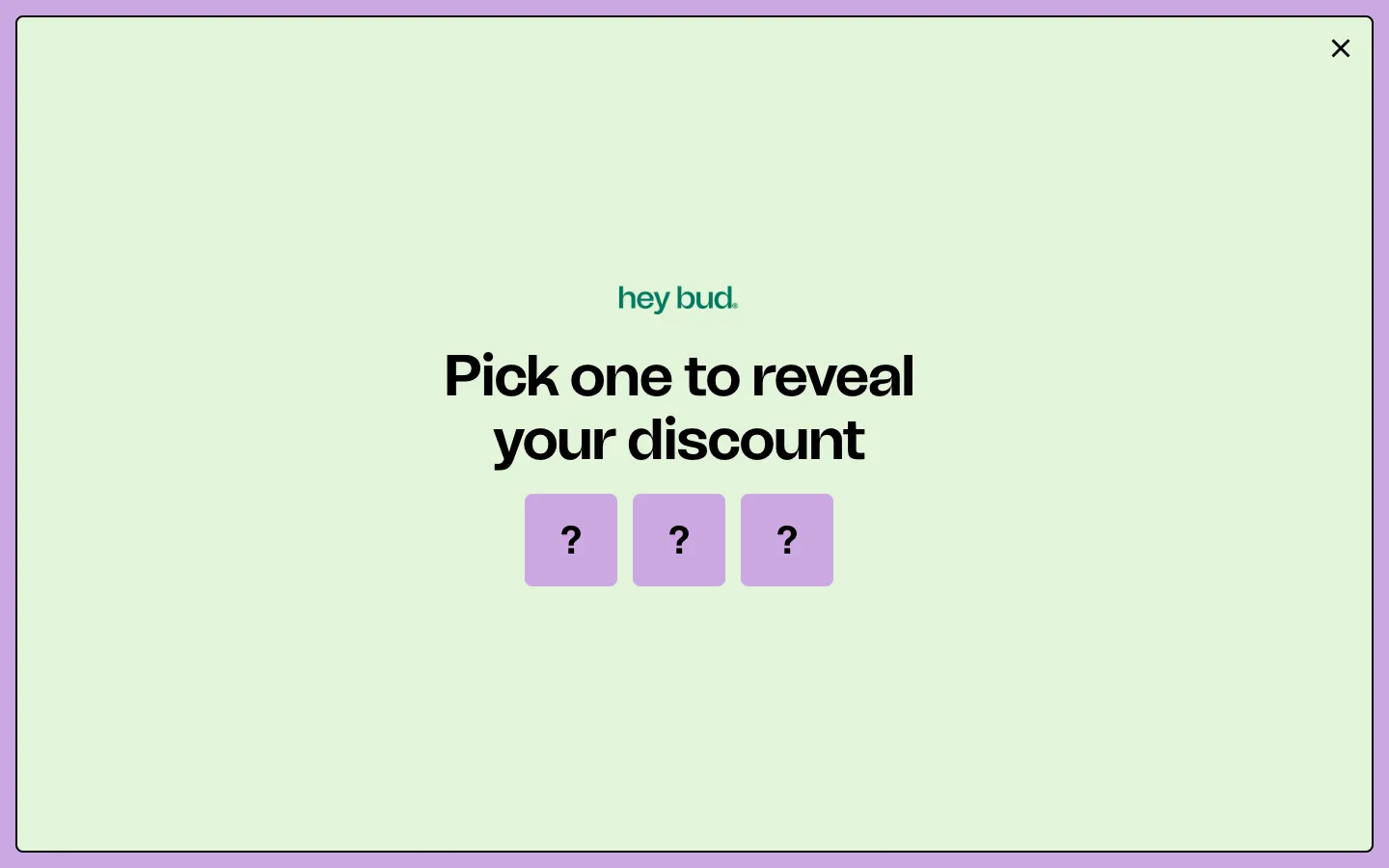
Hey Bud strips the game to its minimum. A pale green screen, the logo, a headline, "Pick one to reveal your discount", and three purple tiles with question marks. There is no photograph and no second message. The screen asks for exactly one action, which is the lightest game of the five.
It resembles Alia's mystery-box step, where visitors pick a box to reveal a hidden discount, though we have not confirmed which Alia step the store uses.
The app behind them: Alia
All five stores load Alia's script on their live sites (checked 4 November 2026): backend.alia-prod.com/public/embed.js. Alia lists spin to win, scratch-off, pick a card, mystery box and Plinko as gamified steps, and the five designs match those descriptions.
| Store | Alia script on live site | Game seen |
|---|---|---|
| Topicals | Yes | Scratch card |
| Smooche | Yes | Scratch card |
| IM8 | Yes | Card matching (four cards) |
| Grüns | Yes | Card matching (nine cards) |
| Hey Bud Skincare | Yes | Pick a tile |
This is strong evidence, not proof. A script on the page shows that the store uses Alia; it does not show that Alia built every popup on the site, and we did not observe the popups' own network requests. Other apps also offer scratch-card popups, for example Scratchly and ScratchMe, which we have not tested.
Alia is not rare in the library. Our detection flags it on 22 of the 113 published stores as of 4 November 2026, and it missed Topicals, whose script loads after the page, so the true number is higher. Alia also builds ordinary signup popups, so detection alone does not mean a store runs a game. Browse the stores using it on the Alia tool page.
Before you copy one
These checks apply to any gamified popup, not to the stores above.
- Decide what the prize is worth. A game that always awards a discount has a known cost; one that varies needs a rule for how often each prize appears.
- Follow the whole journey. Our captures stop at the opening screen. Check when the email is asked, how the offer is delivered and how the visitor returns to shopping.
- Test it without a mouse. Scratching and tapping tiles need an alternative for people who use a keyboard or screen reader.
- Watch the page. A popup script adds weight. Measure load time before and after.
For the plainer end of the spectrum, see our ecommerce email signup popup examples.
 Topicals
 Smooche
 IM8 Health
 Grüns
 Hey Bud Skincare
 Alia