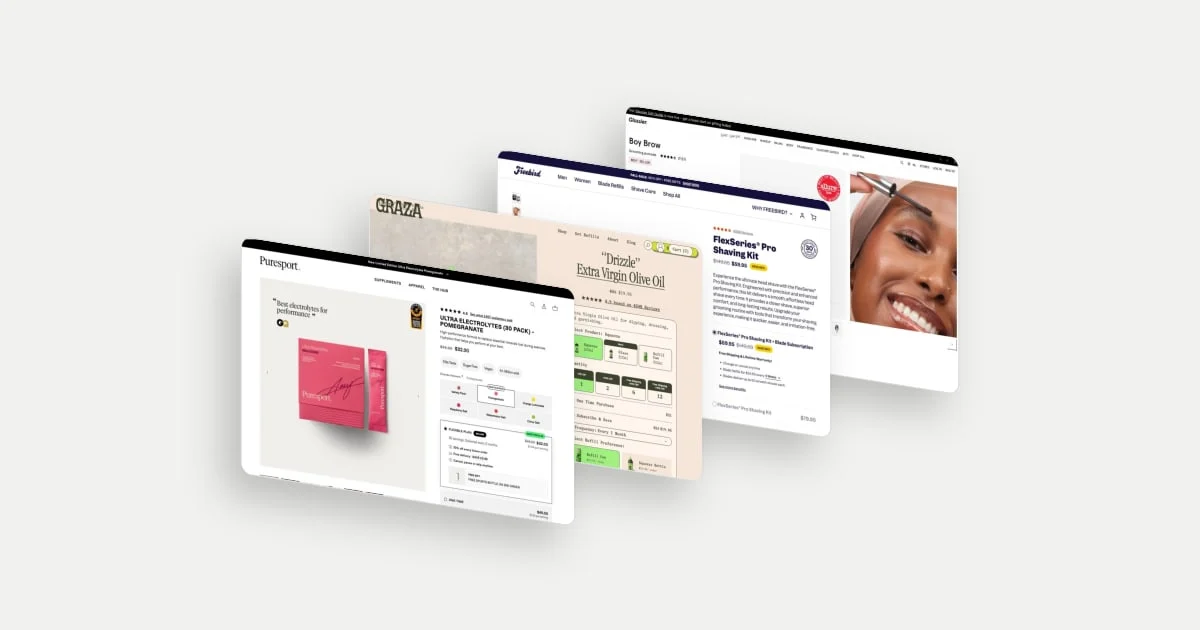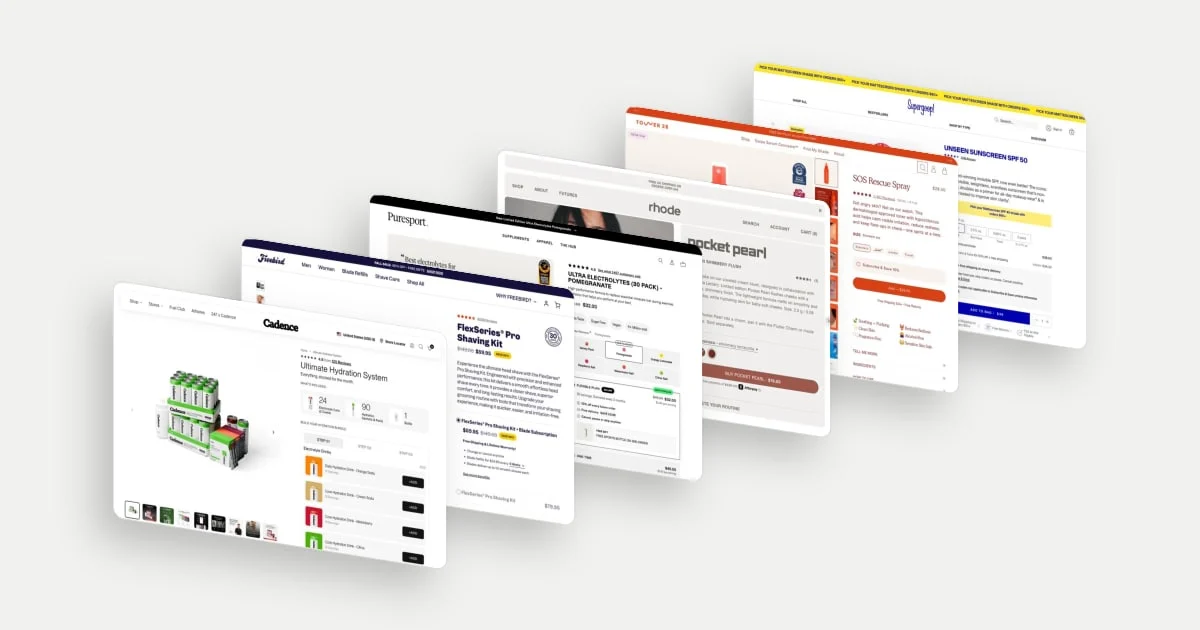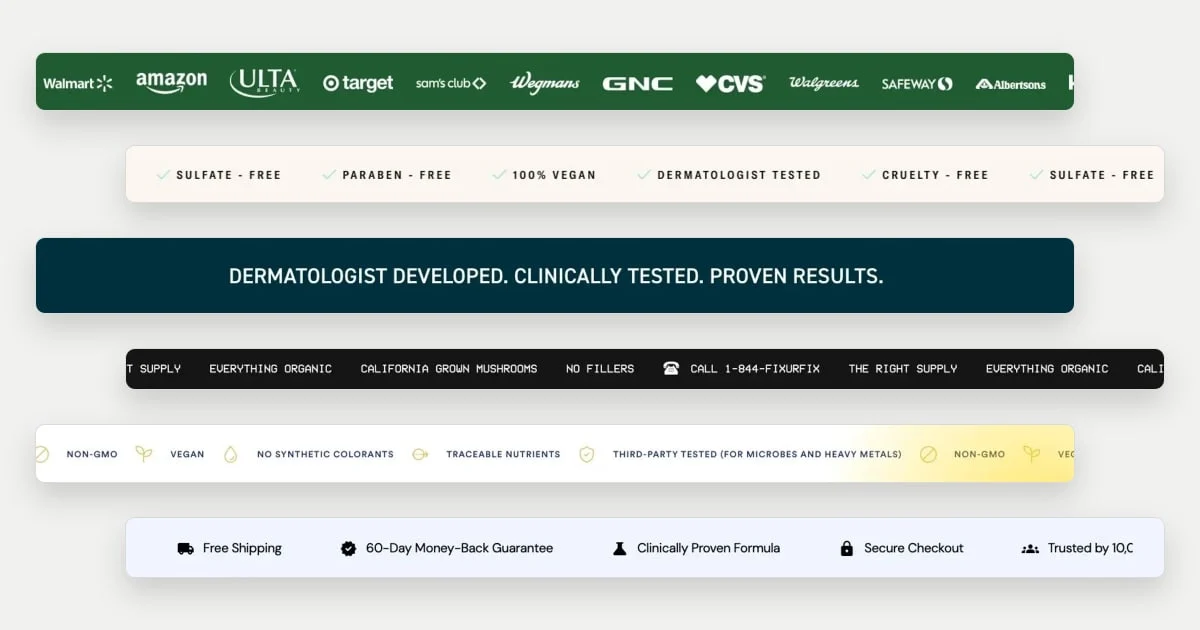
A trust signal is anything on a page that tells a shopper someone else has checked the claim, or that they can check it themselves: a certification, a test report, a retailer's logo, a guarantee. The useful question is not how many to show but which doubt each one answers, and where does the shopper meet it?
These ten examples come from the library's trust signals sections, chosen from 28 across 22 stores to cover different kinds of proof. They are desktop captures of homepage and product page sections from early October to early November 2026, shown at full width. Every certification, test result and count is the brand's own claim. We did not verify any of it, and we do not judge whether a product earns it. This is about how the proof is presented.
What a trust signal can do
| Type of signal | The shopper's doubt | Seen here |
|---|---|---|
| Badges and certifications | Has someone else verified this? | Bite, FLY BY JING, Buffy, Coterie |
| Published proof | Can I check it myself? | Caraway, Coterie |
| Others who vouch | Do other people stock or write about it? | MUD\WTR, sleep or die |
| Taking the risk away | What if it isn't right? | Away, Sundays for Dogs |
| A lot of proof in little space | Can I see it all at a glance? | Ritual |
Two pieces of research help explain the choices. Nielsen Norman Group's study of trustworthiness (2016) found four factors that still shape trust: design quality, up-front disclosure (including return policies and guarantees), comprehensive, correct and current content, and a connection to the rest of the web. In its research people trusted external sources, such as third-party review sites and news outlets, more than company-sponsored content.
Baymard's research on how users perceive security during checkout found that 19% of users had abandoned a checkout in the previous three months because they did not trust the site with their card details (1,026 respondents, 2025). It also observed that parts of a page with trust badges and reassuring microcopy were perceived as more secure, and that people raised security concerns more readily on newer or less-known brands when there were no visual cues. That research is about checkout, not homepages or product pages, and neither source tests the stores below. The examples show the same instinct earlier in the journey.
Badges and certifications
1. Bite: one badge, one idea, all the same size
Bite sets five circular badges in a quiet row on its product page: Certified B Corporation, Vegan, Cruelty-free, Carbon neutral and Woman owned. Each badge makes one claim, they are the same size, and there is no paragraph to read. The section sits where the shopper is deciding.
A shopper can take in all five in a second, and each answers a different kind of doubt: certification, ingredients, ethics, environment and who owns the company.
2. FLY BY JING: let the badges belong to the brand
FLY BY JING's band is red, with three yellow burst badges, "Vegan", "Woman Owned" and "Asian Owned", beside the Non-GMO Project Verified and Certified B Corporation marks. The first three describe the company, and the last two are marks from outside programmes, shown in one row.
The colour and shape make the first three part of the brand's look, so the proof reads as a design element, not as a footer strip.
Explain what the proof means
3. Buffy: say what the certification covers
Buffy does not leave the logo to speak for itself. The headline is "OEKO-TEX Class 1 Certified", and the next line explains: "Class 1 is OEKO-TEX's strictest textiles testing standard" and "Finished product testing certifies textiles safety." Four lines give the specifics: 0 synthetic dyes, 0 phthalates, 0 BPA and BPS, and 0 dye migration (all as the brand states them).
Most shoppers have not heard of the certification, so the section tells them what it is and what it rules out.
4. Caraway: give the claim numbers and somewhere to check
Caraway titles the section "Transparency Is Our Standard". It says every product is independently tested by third-party accredited laboratories and that the reports are public at a named page. Three tick points follow: 600+ types of PFAS and total organic fluorine tested with none detected within reporting limits, 20+ heavy metals tested, and results publicly available. The button reads "Make the Swap From PFAS" and sits next to a product photograph. We did not check the reports; the numbers are the brand's.
The claim is specific, it says where to verify it, and the call to action continues the purchase path.
5. Coterie: scan the endorsements, open the reports
Coterie's homepage shows four cards, each pairing a short claim with the mark behind it: EWG Verified, pediatrician recommended, wipes that are not made of plastic fibers, and National Eczema Association accepted skincare. On the product page, "Our safety standards" lists what the diaper is made without, adds four icons and says results from independent labs are published, with a "Read the Safety Reports" button. All of this is the brand's own description.
A shopper who only wants reassurance gets it from the cards, and one who wants detail gets a route to the reports.
Others who vouch
6. MUD\WTR: show where it is sold and how to find it
MUD\WTR's "Find Us Here" section sets retailer logos, Costco, Target, Sprouts, Erewhon, Amazon and Harmons, on black, with a line about being in thousands of stores nationwide and a "View Store Locator" button.
Retailers a shopper already knows lend credibility to a brand they may not, and the locator gives the section a use beyond proof.
7. sleep or die: put the press logos next to the button
sleep or die closes with a full-colour banner, "dying to sleep?", with a "shop sleep strips" button and a row of publication logos along the bottom: ELLE, ThingTesting, Inc., Forbes, wellworthy and The Globe and Mail. We did not check what each publication said.
The logos sit within a glance of the call to action, so the proof is in view at the moment of the decision.
Take the risk away
8. Away: state the return window and shipping threshold plainly
Away's product page section is headed "We want you to love everything about getting Away". Two items sit under it: "Easy returns", with "Free returns and exchanges for the first 100 days on unused items", and "Free shipping", with "Free shipping over $100*".
Return window and shipping threshold are stated in numbers, in plain words, on the page where the shopper is about to commit.
9. Sundays for Dogs: make the guarantee a headline with a next step
Sundays for Dogs gives its guarantee a whole panel: "14-Day Money Back Guarantee" in large type, a "Find Your Recipe" button, and a photograph of a dog with the words "Excellent customer service".
The guarantee is a headline, not a footnote, and the button moves the shopper to the next step while the reassurance is fresh.
A lot of proof in little space
10. Ritual: six proof points in one row of icons
Ritual fits six proofs into one row, each with a small icon and a few words: "2.6 Billion Capsules Sold", "Clean Label Project Certified", "100% Ingredients Made Traceable", "$5M Investment in Clinical Studies", "Formulated by Dietitians & Scientists" and "Vegan & Non-GMO". They are the brand's claims, shown without paragraphs.
The row mixes scale, certification, traceability, research and expertise, so a shopper with any of those doubts finds an answer in a single glance.
Before you copy one
These checks apply to any trust section, not to the brands above.
- Show only what is true and current. Certifications lapse and counts change. NN/g's list includes correct and current content for a reason.
- Say what a badge means. A logo most shoppers do not recognise needs a sentence, as in the Buffy example.
- Put proof where the decision is. Product pages, next to buttons and near the checkout carry more weight than a band no one scrolls to.
- Check the phone. These are desktop captures; look at how rows, tickers and logos behave on a small screen.
To browse more, see every trust signals section in the library. Many of the same signals sit on product pages, which our product page design examples cover.
 Bite
 FLY BY JING
 Buffy
 Caraway
 Coterie
 MUD\WTR
 sleep or die
 Away
 Sundays for Dogs
 Ritual